If your air conditioner has needed service two or three summers in a row, the real question is no longer whether it can be fixed. It is whether another patch job is worth it, or whether AC installation would actually cost you less over the next decade. At Priority Comfort Heating & Air Conditioning, LLC, we walk homeowners through that decision every cooling season, and the answer usually comes down to age, refrigerant type, and how often the system has failed.
The Short Answer: Repair Still Makes Sense Sometimes
A repair is usually the smarter choice when the system is under 10 years old, still holds refrigerant properly, and the failure is a single component like a capacitor, contactor, or condenser fan motor. Those parts wear out on healthy equipment and replacing them does not signal deeper trouble.
Replacement moves to the front of the line when the failure involves the compressor, the evaporator coil, or a refrigerant leak inside a sealed section of the system. Those are the expensive, labor-heavy repairs, and on an older unit they buy you time rather than reliability.
Six Signs Your Air Conditioner Is Telling You It’s Done
1. The System Is 12 to 15 Years Old
Most residential split systems in southeastern Pennsylvania last 12 to 15 years, and units that were undersized, oversized, or rarely serviced often fall short of that. Once a system passes the 12-year mark, every major repair is an investment in equipment that is already near the end of its service life.
2. You’ve Called for Service More Than Twice in Two Seasons
One breakdown is bad luck. A pattern of failures usually means multiple components are aging out at the same time, and fixing one puts extra strain on the others. Track your invoices: if you have had three or more service calls across two cooling seasons, the trend matters more than any single diagnosis.
3. Your System Still Uses R-22 Refrigerant
Production and import of R-22 (often called Freon) ended in the United States on January 1, 2020 under the EPA’s phaseout schedule, so any remaining supply is reclaimed or stockpiled and priced accordingly. If your outdoor unit’s data plate says R-22 and it has a leak, replacement is almost always the more sensible route.
4. Cooling Bills Keep Climbing While Comfort Drops
Air conditioning and space cooling account for roughly 12 percent of total home energy expenditures nationally, according to the U.S. Department of Energy. An aging compressor works harder for less output, so your utility bill rises even though the house feels warmer. Compare July bills year over year, adjusting for weather, and the pattern usually shows up clearly.
5. Some Rooms Never Get Comfortable
Second-floor bedrooms that run 4 to 6 degrees warmer than the thermostat setting point to a capacity, airflow, or duct problem. Sometimes that is fixable with duct sealing and balancing. Other times the system was never sized correctly for the house, and a replacement sized with a proper load calculation solves what a decade of repairs could not.
6. The House Feels Clammy Even When It’s Cool
Humidity control is half the job of an air conditioner, and a system that short-cycles or has lost capacity will hit the temperature setpoint without pulling enough moisture out of the air. If your home sits above 60 percent relative humidity during a muggy August stretch, the equipment is not keeping up.
The Repair-Versus-Replace Math Homeowners Actually Use
The common rule of thumb: if a single repair approaches half the value of a new system, and the equipment is past 10 years old, replacement generally wins. A second, simpler test is cumulative. Add up what you have spent on the same unit over the past three seasons and ask whether that money bought you dependable cooling or just another summer of uncertainty.
Factor in three things that repairs never fix:
- Efficiency that has degraded with every leak, coil fouling, and compressor cycle.
- Warranty coverage, since new equipment carries manufacturer parts protection while your old unit almost certainly does not.
- Refrigerant availability, which is tightening across older product lines.
What Changed in Efficiency and Refrigerant Standards
Federal minimum efficiency standards now use SEER2 ratings, with a minimum of 13.4 SEER2 for split-system air conditioners in the northern region, which includes Pennsylvania. Many homeowners replacing a 10 SEER unit from the mid-2000s see a meaningful drop in cooling energy use simply from meeting current standards, and more still from stepping up to a two-stage or variable-speed system.
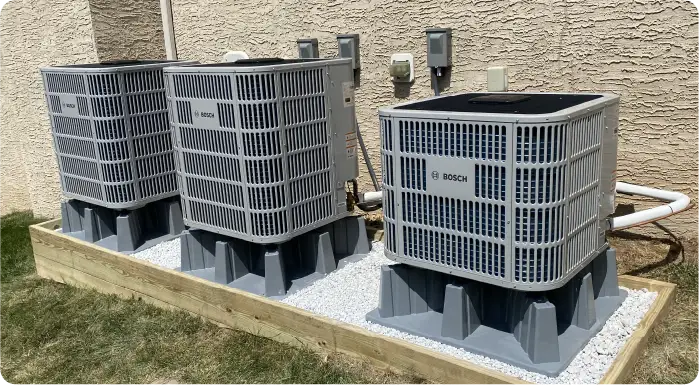
The refrigerant picture shifted too. As of 2025, new residential systems use lower-global-warming-potential A2L refrigerants such as R-454B instead of R-410A. That matters if you are considering a partial replacement, because mixing old and new refrigerant components is not an option. Priority Comfort Heating & Air Conditioning, LLC will explain which refrigerant your current system uses and what that means for parts availability.
Good Maintenance Changes the Answer
A system that has had annual tune-ups (coil cleaning, refrigerant charge verification, electrical checks, condensate line clearing) often earns a few extra years of reliable service. A neglected system frequently fails a decade in. If your unit is borderline on age but has a clean service history, a repair may well carry you through several more summers.
That is why we encourage homeowners to keep up with AC maintenance in Phoenixville, PA rather than waiting for a summer emergency. Documented maintenance also protects manufacturer warranty coverage on newer equipment, which many homeowners lose without realizing it.
What a Proper Replacement Actually Involves
Swapping a box for a box is where bad installations start. A quality replacement includes a Manual J load calculation based on your home’s square footage, insulation, window area, and orientation, not a guess based on the old unit’s tonnage. Oversized systems short-cycle, cool unevenly, and leave humidity behind.
A thorough job also covers:
- Inspection of existing ductwork for leakage, undersized returns, and crushed runs.
- Replacement or flushing of the refrigerant line set, depending on the refrigerant change.
- A matched indoor coil and outdoor condenser, since mismatched pairs never hit their rated efficiency.
- Proper evacuation and charge verification, plus airflow measurement at startup.
- Registration of the manufacturer warranty in your name.
Homeowners scheduling AC installation in Collegeville, PA get all of that as standard practice, along with a walkthrough of thermostat settings and filter sizing before we leave.
How to Decide Without Guessing
Bring three pieces of information to the conversation: the manufacture date on your outdoor unit’s data plate, the refrigerant type listed there, and your repair history. Those three facts settle most repair-versus-replace debates before a technician opens a panel. Our team at Priority Comfort Heating & Air Conditioning, LLC will give you both options in writing when repair is genuinely viable, because plenty of systems have life left in them.
Ready to Stop Paying for the Same Repair?
If your air conditioner has become the most unpredictable appliance in the house, let Priority Comfort Heating & Air Conditioning, LLC evaluate whether one more fix makes sense or whether replacement is the better investment. Contact us today for a straight assessment of your system’s age, refrigerant, and condition.